How Can Ahrefs DR Compare to Moz DA: Key Differences
Businesses often apply third-party metrics to evaluate web property authority and backlink strength. Ahrefs Domain Rating (DR) and Moz Domain Authority (DA) rank among the best-known measures, but they explanation distinct questions.
The Basics of Ahrefs DR vs Moz DA
Understanding How Does Ahrefs DR Compare to Moz DA supports teams select the right metric for each SEO task. DR measures backlink profile strength, while DA estimates a domain’s ranking likelihood relative to additional domains. This Ahrefs vs Moz distinction matters when teams interpret reports.
Neither score comes from Google, and neither guarantees higher rankings in real-world use. Google also evaluates relevance, content quality, search intent, link quality, and other site-wide signals.
Anatoly Zadorozhnyy is an SEO and digital marketing expert who has helped businesses grow through organic search since 2008. With more than 18 years of industry experience, he has supported hundreds of companies in earning qualified visitors, first-page visibility, and rankings for thousands of keywords.
Essential Lessons
- Ahrefs DR measures backlink profile strength in many cases.
- Moz DA estimates relative ranking potential in many cases.
- Ahrefs vs Moz scores are not Google ranking factors in real-world use.
- One DA 50 score does not equal a DR 50 score.
- Businesses should use these metrics for research, not as final business findings.
The Main Ahrefs Domain Rating And Moz Domain Authority?
Ahrefs Domain Rating and Moz Domain Authority are third-party SEO metrics in practice. Both apply a scale from 0 to 100, but they assess site strength differently. Marketers apply them to compare sites, review competitors, and study backlink profiles.
Such scores work best as research tools. A higher number does not guarantee greater visitors, better content, or stronger sales. Each platform uses its own data and calculation approach.
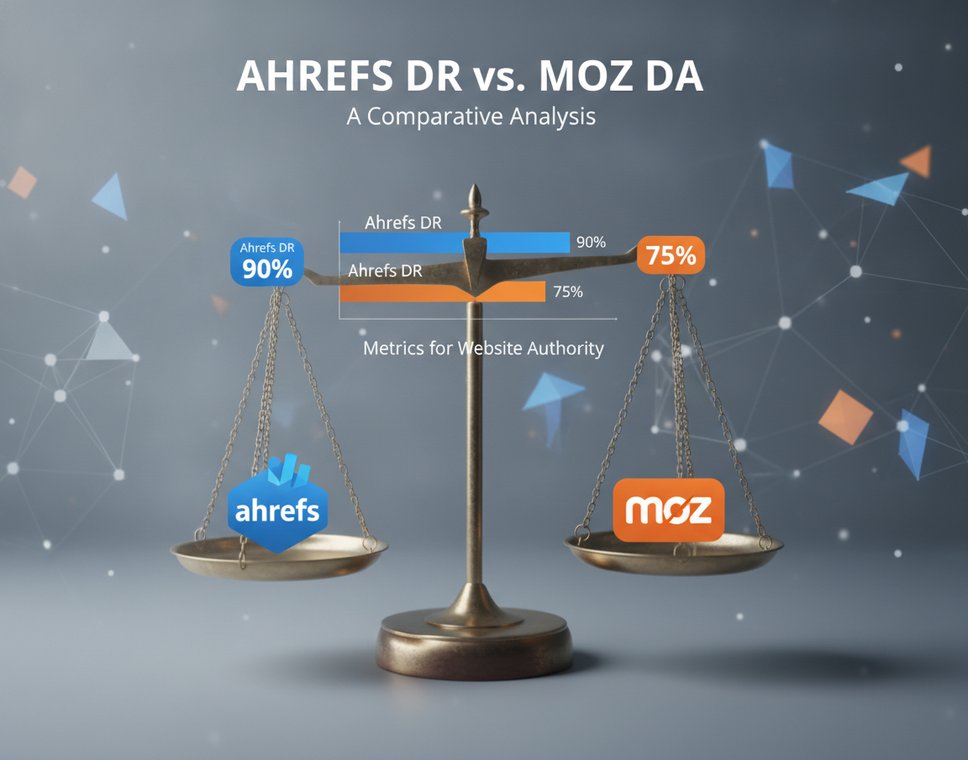 Ahrefs DR vs Moz DA
What Ahrefs Domain Rating Measures Explained
Ahrefs Domain Rating measures a site’s backlink profile strength. It uses a logarithmic scale from 0 to 100. Every increase becomes harder to achieve as the score rises.
The metric considers unique referring domains, linking-website authority, followed links, and link equity across the link graph. Only the initial followed link from each referring domain adds value to the score.
A linking website passes less benefit when it links to many other domains. This dilution explains why one solid referring domain may matter more than many links from one site. Ahrefs Domain Rating does not directly measure organic visits, domain age, or written material quality.
Ahrefs states that its score excludes spam signals in many cases. Many weak links can raise a site’s score, so those links still require careful review.
What Moz Domain Authority Measures
Moz Domain Authority predicts how well a web property might rank in search results against other sites. It works with link data and machine learning to produce a score from 0 to 100.
Moz Domain Authority is a relative measure, not a direct report of Google performance in practice. The score may change when a site gains or loses links, or when stronger competitors enter the wider index.
The metric may assist competitor research and link prospecting. It does not confirm that a webpage matches search intent, supplies useful information, or attracts qualified visitors.
Why Neither Metric Is A Google Ranking Factor: A Practical Guide
Google does not work with Ahrefs Domain Rating or Moz Domain Authority in its ranking systems. These scores come from independent SEO platforms, not Google Search.
Google evaluates many signals, including relevance, page standard, usability, links, and search intent. A domain with a modest score can help to rank well for a focused topic. A high-scoring domain can help to rank poorly when its page fails to meet the searcher’s need.
Therefore, both metrics work best alongside real performance data in many cases. Organic clicks, impressions, conversions, and closely related referring domains provide a fuller view of SEO health.
| Metric | Primary focus in many cases | Useful for | Key limitation in real-world use |
| Ahrefs Domain Rating in real-world use | Backlink profile strength in practice | Reviewing referring domains and link equity in practice | Does not measure organic visits, page copy quality, or spam risk directly |
| Moz Domain Authority in many cases | Relative ranking potential in real-world use | Comparing competing websites in real-world use | Does not represent a Google ranking consideration or guaranteed performance |
How Does Ahrefs DR Compare To Moz DA: Key Differences
Ahrefs Domain Rating and Moz Domain Authority assess distinct dimensions of website strength. A clear Domain Rating Comparison supports marketers interpret each score carefully. Although the numbers seem similar, they answer separate SEO questions.
DR Focuses On Backlink Strength Explained
Ahrefs DR asks, “How solid does this domain’s backlink profile appear?” It evaluates the quality and authority of referring domains linking to a site. One link from a solid site may carry more weight than many links from weak sites.
DR helps backlink prospecting, link building campaigns, and backlink gap analysis. SEO teams may monitor competitor link acquisition and detect updates in a site’s link profile. Ahrefs has found an index of 44.8 trillion links, with fresh data processed approximately every 15 to 30 minutes.
DA Predicts Relative Ranking Potential Explained
Moz DA estimates a domain’s likelihood of ranking against other domains in search findings. It works with a 1-to-100 scale and draws on link signals from the Moz index. One higher DA indicates stronger relative ranking potential, but it does not guarantee a position.
DA suits broad competitor reviews and rapid site comparisons. It does not reveal the exact value of one backlink. The score presents broader domain authority, whereas DR emphasizes backlink strength and link equity.
Side By Side Comparison Of Ahrefs DR And Moz DA: A Practical Guide
That DR vs DA comparison explains why the scores should not function as equal grades. Each tool works with its own crawler, index, calculations, and update approach.
| Measure | Ahrefs DR | Moz DA |
| Main purpose | Measures the strength of a domain’s backlink profile in many cases | Predicts relative ranking potential in many cases |
| Primary focus in practice | Referring domains, link authority, and link distribution in many cases | Link signals and competitive ranking patterns in real-world use |
| Score range | 0 to 100 | 1 to 100 |
| Common apply | Link prospecting, gap analysis, and campaign tracking in many cases | Competitor research and broad domain comparisons in practice |
| Best reading | How powerful does the backlink profile look in many cases? | How likely is the domain to rank against others in practice? |
For a reliable Domain Rating Comparison, analysts should apply the same tool to every reviewed web property. The DR vs DA gap may reflect separate databases, rather than a problem with either site.
Why DA 50 And DR 50 Do Not Mean The Same Thing: A Practical Guide
DA 50 and DR 50 look equal, yet they measure different signals. Each platform uses its own crawler, link index, weighting system, and scoring goal, so direct comparisons remain unreliable.
Ahrefs metrics measure the strength of a web property’s backlink network. Domain Rating shows how much authority moves through that network, using referring domains and their link profiles. A domain with fewer links from effective domains may earn a higher DR than one with many weak links.
Moz ranking metrics apply machine learning to estimate a website’s ability to rank against competing domains. Domain Authority is relative, so its value may change when a site gains links or the wider web shifts. A DA score does not illustrate a fixed amount of authority.
DR uses a logarithmic scale. Moving from DR 20 to DR 30 can require far less link strength than moving from DR 70 to DR 80. The upper range is harder to reach because each step represents a larger gap in backlink power.
These differences matter when businesses review competitors, publishers, or outreach prospects. Ahrefs metrics help assess link graph strength, while Moz ranking metrics supply a broader estimate of competitive ranking potential. This scores work best as separate benchmarks, not matching grades.
Situations Where Should Businesses Use Ahrefs DR Or Moz DA?
Businesses may use both metrics for research, but each supports a different task. Ahrefs Domain Rating measures backlink network strength, while Moz Domain Authority estimates comparative ranking potential in many cases.
When Ahrefs DR Is More Useful
Ahrefs Domain Rating serves as an early filter for backlink prospects in many cases. Marketing teams can help to assess referring-domain strength, track link growth, and monitor competitor link acquisition.
DR works best when teams study raw backlink power in real-world use. One high score alone does not make a link valuable. Teams should assess backlink standard, outbound link volume, page copy quality, organic traffic, and topical relevance.
- Screening sites for outreach campaigns in many cases
- Comparing the strength of referring domains in real-world use
- Tracking updates in a competitor’s link profile
- Finding gaps in a brand’s backlink network in real-world use
When Moz DA Is More Useful
Moz Domain Authority assists teams compare sites within the same market. This approach offers a broad view of relative ranking potential among competitors, publishers, and partners.
DA helps campaign planning when businesses need simple comparisons across many domains. This approach suits prospect lists, competitor reviews, and reports requiring an accessible authority estimate.
Teams should treat DA as a comparison signal, not a promise of search performance in practice. Content depth, user intent, technical health, and actual organic organic visits still influence findings.
Methods For Choose The Right Metric For The Decision
The appropriate metric relies on the query. Ahrefs Domain Rating suits link-focused research, while Moz Domain Authority suits broad comparisons of ranking potential in practice.
- Use DR to assess backlink network strength.
- Apply DA to compare relative authority within a market.
- Review traffic, relevance, written material quality, and link placement before making a choice.
- Match the metric to the campaign goal, such as outreach, reporting, or competitor research in real-world use.
A sound review treats the score as a starting point. A backlink’s full value depends on trust, context, audience fit, and the receiving page’s quality.
What Ahrefs DR And Moz DA Both Miss Explained
Domain scores offer a helpful starting point, but they cannot describe an entire site. A powerful domain might host weak pages, while a smaller website may publish one excellent page with trusted links and steady traffic. A careful DR vs DA review should assess site strength, relevance, and actual search performance.
Page Level Strength Explained
Ahrefs Domain Rating and Moz Domain Authority describe domains at a broad level in real-world use. These scores can conceal the page strength behind a backlink. A relevant article with solid referring links may offer more value than a high-scoring domain page with little authority.
Ahrefs URL Rating offers a webpage-level view based on its link profile. Moz Page Authority offers a comparable view through Moz link data in practice. Page Authority does not automatically change when Ahrefs DR or Moz DA adjustments, because each platform uses a separate index and calculation process.
These Ahrefs metrics assist users compare individual pages additional carefully. A linking webpage should provide clear content, useful references, and evidence of earning organic attention.
Topical Relevance And Search Intent Explained
Neither DR nor DA shows whether a page suits the target site’s topic. A respected health publication might offer limited utility to a software company when its article lacks a clear connection. Relevance supplies context and assists readers understand why the link appears.
Search intent matters equally. A site that answers a user’s question can strengthen trust and engagement. A high domain score cannot demonstrate whether written material satisfies the needs behind a search query.
When reviewing DR vs DA, marketers should read the linking webpage and examine its subject. The page should address a related concern, present accurate information, and make the link feel natural.
Organic Visibility And Link Quality Explained
Domain scores do not confirm that a site receives Google visits. A site may have many links yet attract little organic traffic. Traffic trends, indexed pages, ranking terms, and engagement data offer a clearer view of active visibility in real-world use.
Link quality extends beyond the number of referring domains. Editorial links from trusted, relevant pages send stronger signals than sitewide links, paid placements, or pages crowded with unrelated references.
Ahrefs metrics and Moz scores can help to resource research, but they work best with page-level review and traffic data. This broader assessment supports businesses judge backlink opportunities with greater precision.
Ways To Evaluate A Backlink Opportunity Beyond DR And DA
Relevance forms the basis of a effective backlink. The linking site should serve the business’s audience, and its proposed webpage should relate to the target page. A trusted health publication might assist a medical practice, but it may offer little value to a home improvement company. Domain Rating Comparison may help screen potential sites, but it cannot replace this review.
Moz ranking metrics supply another view of site strength. However, a high score cannot illustrate whether a specific page will attract qualified visitors or support the target topic.
The proposed linking page should be indexable and valuable. It should load properly, offer straightforward information, and appear in search results. A webpage behind a login, blocked from crawlers, or filled with thin content offers limited value, even when its site shows strong authority signals.
Organic performance offers a clearer view of website health. Review its ranking keywords, estimated search traffic, and traffic trends over time. Steady growth can signal useful content and sound publishing practices. A sharp decline may indicate lost trust, outdated pages, or a search algorithm change.
- Topic fit: The webpage should match the business, audience, and link destination.
- Content standard: The article should offer original facts, expert insight, or practical help.
- Organic reach: The page should rank for relevant terms or attract visitors from search.
- Editorial standards: The website should review content and publish useful updates.
- Page history: The publisher should maintain links, facts, and active pages in practice.
Publishing habits also matter in many cases. A website that accepts every submission can carry unrelated topics, paid links, or repeated promotional language. A focused publication with straightforward standards often generates stronger context for a useful citation.
| Review area | What to check in practice | Why it matters in many cases |
| Relevance | Topic, audience, and link placement in practice | Improves context and visitor quality |
| Indexability | Search access, crawl status, and page availability | Allows search engines to find the linking site |
| Unpaid visibility | Ranking terms, visitors levels, and recent trends | Shows whether the site can help to attract real visitors |
| Content standards in practice | Original research, easy-to-follow writing, and editorial review | Supports trust and lasting usefulness in real-world use |
| Page maintenance in practice | Fresh facts, working links, and active updates in many cases | Protects the benefit of the backlink over time |
What SEO Metrics Should Businesses Track Instead?
Domain scores may inform research, but they should not control every SEO decision. Businesses need measures tied to visibility, customer utility, and revenue. Page-level data often supplies clearer insight than one score covering an entire domain.
Search And Business Performance Metrics Explained
Teams should track rankings for priority pages and target keyword groups in practice. Organic clicks demonstrate whether those rankings attract meaningful search activity. Qualified organic visits reveals whether visitors match the company’s ideal customer profile.
Business outcomes matter as much as search visibility. Useful measures cover form submissions, phone calls, sales leads, conversion rates, and revenue from organic traffic. Google Search Console may assist separate branded queries from nonbranded searches.
- Rankings for central pages and keyword groups
- Unpaid clicks and impressions
- Qualified, nonbranded visitors
- Leads, sales, and conversion rates in real-world use
- Revenue linked to organic search in real-world use
DA, DR, And SEO In The Age Of AI Overviews: A Practical Guide
AI Overviews may change how people discover information. A site can receive fewer clicks while remaining visible in search results. Companies should monitor impressions, clicks, citations, and visits from pages answering detailed questions.
The request How Does Ahrefs DR Compare to Moz DA helps teams interpret link data. It cannot illustrate whether a page satisfies search intent. In an Ahrefs vs Moz review, site visibility, page copy quality, and conversions deserve more weight than a domain-wide score.
Affordable SEO Services For Sustainable Organic Growth Explained
Affordable SEO services should prioritize practical improvements over lengthy reports filled with surface-level scores in many cases. A helpful plan can include technical fixes, content updates, local search work, link evaluation, and monthly performance reviews.
Small businesses can begin with a short list of priority pages. They may improve pages already earning impressions, strengthen weak conversion paths, and create content around proven customer needs. That approach makes SEO spending easier to measure over time.
| Metric | What It Shows in real-world use | Why It Matters in real-world use |
| Unpaid clicks | Visits from unpaid search results | Shows whether search visibility attracts users in real-world use |
| Nonbranded organic visits | Visitors who do not search for the company name in real-world use | Measures reach among new audiences in many cases |
| Qualified visitors | Visits from applicable potential customers | Links SEO activity to customer fit in many cases |
| Conversions | Leads, calls, purchases, or sign-ups in real-world use | Connects search work to business goals in real-world use |
| Revenue | Income tied to organic visitors in practice | Shows the financial utility of SEO |
| Page-level visibility in practice | Performance of individual pages and queries in practice | Provides more valuable detail than one domain score |
Summary
Moz Domain Authority and Ahrefs Domain Rating help businesses evaluate site strength, but they measure different signals. Ahrefs Domain Rating measures backlink profile strength, whereas Moz Domain Authority estimates a domain’s relative ability to rank in search findings.
Ahrefs Domain Rating often assists backlink prospecting, link-building analysis, and backlink gap research. Moz Domain Authority supports compare similar businesses competing for the same search terms and audiences.
Neither score should overview decisions alone. A stronger evaluation considers webpage standard, topical relevance, search intent, organic traffic, link quality, and business results. Together, Moz Domain Authority and Ahrefs Domain Rating can help to support clearer SEO decisions and steady growth.